 647-348-4995


- June 24, 2026
-
 Talon Uddin
An email landed in one of our inboxes this morning, and it stopped me mid-coffee. The sender was the OpenAI Ads Platform, and the subject line read like something out of a marketing prediction deck from two years ago: "You're invited to advertise on ChatGPT." If you run a business in Canada, there's a good chance the same invite is either sitting in your inbox now or about to be. After months of testing in the United States, OpenAI is opening its advertising platform to Canadian advertisers, and I think it's one of the more interesting shifts in paid media I've seen since Performance Max landed. Here's my honest, no-hype breakdown of what ChatGPT Ads actually are, what they cost, and whether they deserve a slice of your budget.
Not sure where ChatGPT Ads fit alongside your Google Ads budget?
We help Canadian businesses test new paid channels without torching their budgets. Let's map out a smart plan together.
So, What Exactly Are ChatGPT Ads?
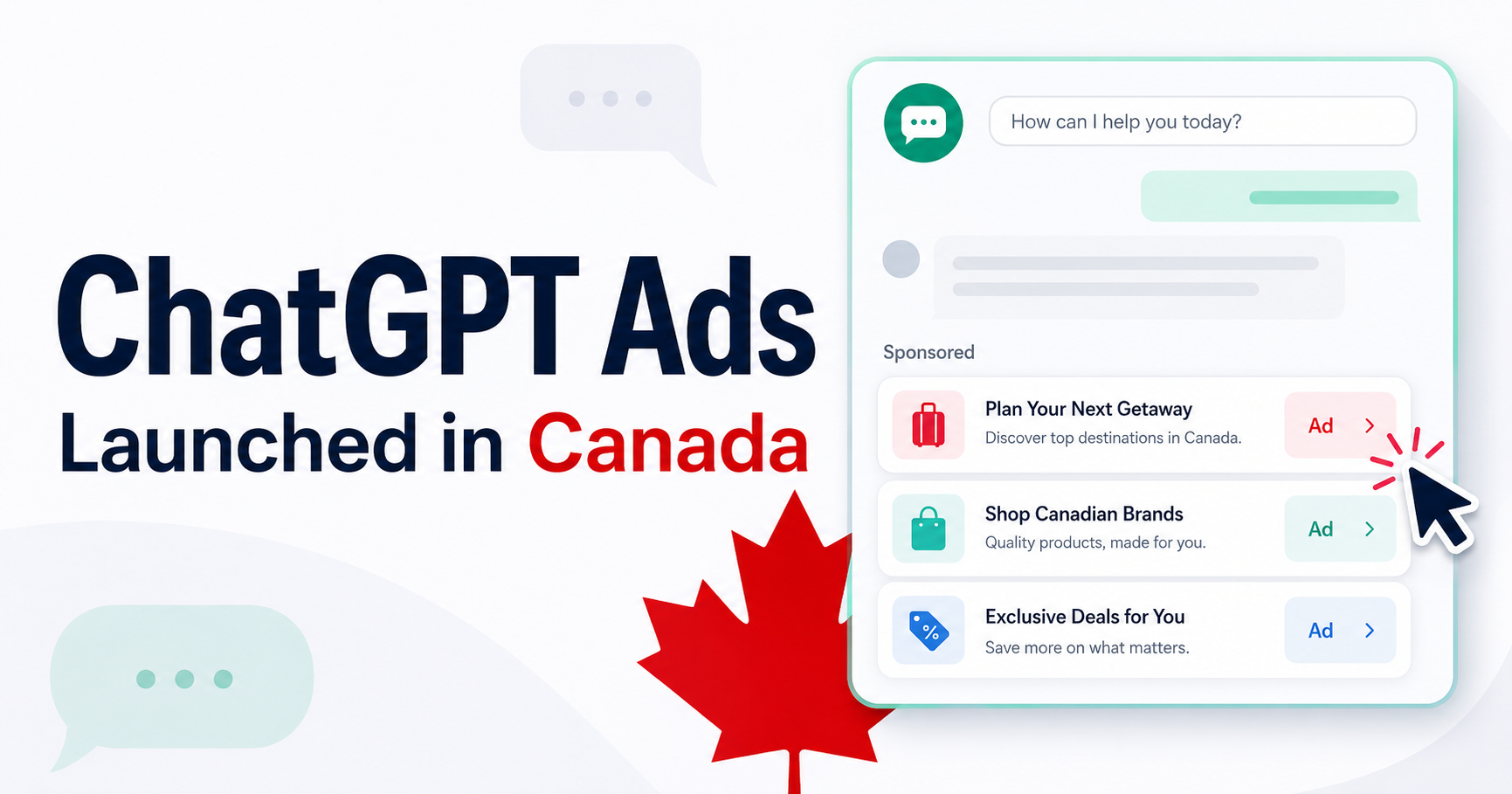
The short version: when someone is chatting with ChatGPT and the conversation lines up with a relevant product or service, a clearly labelled sponsored card can appear below the AI's answer. Not inside it. Not influencing it. Below it, with a "Sponsored" label and a visual separation from the actual response.

OpenAI started testing this in the U.S. on February 9, 2026, and they've been deliberate about the guardrails. A few things I want you to understand up front, because they shape everything about whether this channel is worth it for you:
- Ads only show to free and "Go" tier users. Anyone on Plus, Pro, Business, Enterprise, or Education plans never sees an ad. That's a big deal, and I'll come back to it.
- No ads to users predicted to be under 18. OpenAI excludes minors from the ad experience entirely.
- Your conversation stays private. Advertisers never see your chats, history, or personal details — only aggregated, non-identifying performance numbers like total clicks and impressions.
- The ad doesn't shape the answer. OpenAI runs ads on a separate system from the chat model, which they call "answer independence." The model recommends what it thinks is useful; the ad is a paid placement next to it.
If you want it straight from the source, OpenAI laid out the whole approach in their official announcement on testing ads in ChatGPT, and their Help Center basics page covers the nuts and bolts.
Why This Matters for Canada Right Now
For most of 2026, this was a U.S.-only experiment. That's changed. OpenAI has confirmed it's expanding the pilot beyond the States — Canada, Australia, and New Zealand are first in line, with more markets planned through the year. The invite emails now landing in Canadian inboxes are the front edge of that rollout.
Here's why the timing is worth paying attention to. ChatGPT is used by hundreds of millions of people, and a huge share of them are on the free tier — exactly the audience that sees ads. When someone opens ChatGPT, they're often not idly browsing. They're actively trying to decide something: which CRM to buy, which contractor to call, where to take a weekend trip, how to handle a legal issue. That's high-intent territory, and high intent is the whole game in paid media. Whether you run campaigns yourself or work with a team to manage Google Ads across Canada, a new pool of decision-stage attention is something you want to understand early.
How ChatGPT Ads Actually Work
If you've ever set up a Google Ads campaign, the workflow will feel familiar. After you sign up at the OpenAI Ads platform, you land in Ads Manager and follow three broad steps:
- Create your campaign. Set your budget, your goal, and your bidding model.
- Add your ad details. Build them in the tool directly or bulk upload. The current format is a sponsored card with a title, a short description, an image, and a destination link.
- Launch and learn. Track impressions, clicks, spend, and conversions, then optimize.

The biggest mental shift from Google is targeting. There are no keyword match types here. Instead, you give "context hints" at the ad group level — descriptions of the topics, conversations, and situations where your product is relevant. OpenAI's system then uses a relevance-weighted, second-price auction to decide which ad fits a given conversation best. You're not bidding on the word "plumber." You're telling the system, in effect, "show me when someone's dealing with a burst pipe or shopping for a renovation."
You can buy two ways: a Clicks objective billed on cost-per-click (CPC), or a Reach objective billed on cost-per-thousand-impressions (CPM). For tracking, you can drop UTM parameters on your landing page URLs and watch the traffic flow into Google Analytics like any other channel, plus there's a pixel and a Conversions API for measuring what happens after the click.
What Do ChatGPT Ads Cost?
This is the question every business owner asks me first, so let's get concrete. All figures below are in USD, since that's how OpenAI quotes them — budget accordingly for the exchange rate.
| Pricing lever | What to expect (mid-2026) |
|---|---|
| CPC (cost per click) | Recommended starting max bid of $3–$5 per click. Some early advertisers have reported real-world clicks landing under that as competition is still thin. |
| CPM (cost per 1,000 impressions) | Default max bid around $60, though real rates have reportedly eased toward the $25–$45 range as the auction matured. |
| Minimum spend | Early launch partners faced six-figure commitments. With the self-serve Ads Manager Beta, the minimum was removed for approved U.S. advertisers — expect Canadian access to follow a similar self-serve path. |
| Auction type | Relevance-weighted, second-price. Relevance to the conversation matters as much as your bid. |
Put that next to a Canadian Google Ads account and the picture gets interesting. In a lot of high-value B2B and professional service verticals, Google clicks have gotten brutally expensive — legal, home services, and SaaS keywords can run far north of a $3–$5 click. So on raw CPC, ChatGPT can actually look cheap for those categories. The catch is volume and maturity, which I'll get to.
ChatGPT Ads vs. Google Ads: An Honest Side-by-Side
I don't want you to read this as "the new thing kills the old thing." It doesn't. Google Ads is still the workhorse, and for most of my clients it's where the bulk of the budget belongs. But the differences are worth understanding:
| Factor | Google Ads | ChatGPT Ads |
|---|---|---|
| Targeting | Keywords, audiences, intent signals | Conversational context hints — no keywords |
| Where the ad sits | Above/within search results, the user is about to leave to find an answer | Below the answer the user already received |
| Audience reach | Essentially everyone who searches | Free & Go tier users only — paid subscribers never see ads |
| Click-through rate | Search benchmarks around 6%+ | Early pilot data has hovered near 1% (verticals range roughly 0.8%–2.3%) |
| Conversion quality | High intent, well-understood | Early data (Criteo) suggests LLM referrals convert ~1.5x other channels |
| Measurement maturity | Deep, battle-tested | Young — pixel/API and UTM tracking exist, but reporting still has lag and gaps |
The honest read: ChatGPT Ads get clicked far less often than Google Search ads, but the people who do click tend to be deeper in their decision and convert better. That makes sense when you think about it — the ad shows up after ChatGPT has helped someone work through a problem, so they've already done their homework. If you want to dig into how the search side of the equation is shifting in 2026, our team tracks these benchmarks constantly.
Which Canadian Businesses Should Actually Test This
Not every business should rush in. Based on early-adopter performance and the kind of audience that sees these ads, here's where I'd lean in versus wait:
Strong fit right now:
- Professional services with high deal value. If one closed client is worth thousands, a 1% CTR still pencils out. This is exactly why Google Ads for lawyers works despite punishing click costs — the same math applies on ChatGPT.
- Research-heavy, high-consideration purchases. Financial services, B2B SaaS, education, and travel have been the standout early verticals because their buyers genuinely research inside the chat before deciding.
- Home and local services. Plenty of "how do I fix / who should I hire" conversations carry local intent. Trades like plumbing and high-ticket categories like real estate fit the decision-stage pattern well.
Be cautious for now:
- Low-margin, impulse e-commerce. At current pricing, cheap, short-cycle products have a harder time making the per-click cost work.
- Anyone targeting senior, paid-tier decision-makers. Remember, executives on company-funded Plus and Enterprise plans never see these ads. If your buyer is the CEO, your reach is thinner than the headline user numbers suggest.
Want to test ChatGPT Ads without wasting a dollar?
We build small, measured pilots that tell you fast whether a channel is worth scaling. Let's talk through your goals.
What It Means Market by Market Across Canada
One thing I've learned managing campaigns from coast to coast: a national average hides a lot. ChatGPT Ads will play out differently depending on where your customers are and how competitive your local Google auctions already are.
- Toronto & the GTA: the most expensive Google market in the country for most service industries. That's exactly where a cheaper ChatGPT click could be most appealing as a complement — worth testing for anyone in Canada interested in Google Ads services.
- Vancouver & the Lower Mainland: close behind Toronto on cost, especially in real estate and home improvement. Businesses doing Google Ads in Vancouver should watch this channel closely.
- Calgary & Edmonton: generally cheaper Google clicks than Toronto, but trades and home services stay competitive. A low-cost test through Google Ads in Calgary makes sense here.
- Montreal & Quebec: the French-language question is the one most advertisers will forget. If your customers research in French, your ChatGPT ad copy and context hints need to be French too. We handle this regularly with Google Ads in Montreal, and the same bilingual discipline applies on this new platform.
My Honest Take: Should You Jump In?
Here's where I've landed after watching the U.S. pilot for months. ChatGPT Ads are real, worth understanding, and worth a small, instrumented test — but they are not a place to bet your whole budget yet. The reach is capped to free-tier users, the click-through rates are structurally low, and the measurement tools are still finding their feet. I've seen reporting glitches and choppy early results that would make any results-driven owner nervous.
But that's also the opportunity. Channels are cheapest and least competitive exactly when they're new and unproven. The advertisers who learn this platform now — clean tracking, tight context hints, a modest test budget, a clear cost-per-acquisition target — will know how to scale it the day it matures. My advice: keep 90% of your spend where it already works, carve out a small experiment here, and measure cost per real outcome, not vanity clicks. If you'd like a second set of eyes before you spend a dollar, that's exactly the kind of thing we do.
Frequently Asked Questions About ChatGPT Ads
Are ChatGPT Ads available in Canada yet?
OpenAI has confirmed it is expanding its ads pilot beyond the U.S., starting with Canada, Australia, and New Zealand. Invitation emails to advertise are now reaching Canadian businesses. Availability is rolling out gradually, so exact access and timing can vary — sign up through the OpenAI Ads platform to get on the list.
How much do ChatGPT Ads cost?
OpenAI recommends a starting max bid of $3–$5 USD per click for CPC campaigns, and a default of around $60 CPM for impression-based campaigns (real CPMs have reportedly eased lower as the auction matured). With the self-serve Ads Manager Beta, the old six-figure minimums were removed for approved advertisers, so you can start with a budget that fits a real test.
Do ChatGPT Ads influence the answers the AI gives?
No. OpenAI runs ads on a separate system from the chat model — they call it "answer independence." Advertisers cannot rank, shape, or alter ChatGPT's responses. Ads appear below the answer, clearly labelled as sponsored and visually separated from the organic response.
Who actually sees ChatGPT Ads?
Only logged-in adult users on the free and ChatGPT Go tiers. Anyone subscribed to Plus, Pro, Business, Enterprise, or Education plans never sees ads, and OpenAI excludes users it predicts are under 18. That reach limit is important to factor into your targeting — your most senior, paid-plan prospects are outside this audience.
Is my campaign data and customer data private?
OpenAI states that user conversations are not shared with advertisers and never sold. As an advertiser, you receive aggregated, non-identifying performance data such as total impressions and clicks. If a user chooses to message you through an ad, you only see the messages they send you directly.
How are ChatGPT Ads different from Google Ads?
The biggest differences are targeting and placement. ChatGPT uses conversational "context hints" instead of keywords, and the ad appears below an answer the user already received rather than at the top of a results page. Click-through rates run lower than Google Search, but early data suggests the clicks that do happen convert at a higher rate because the user has already researched their decision in the chat.
Should I drop Google Ads for ChatGPT Ads?
No. ChatGPT Ads are best treated as a small, complementary experiment, not a replacement. Google Ads remains the more mature, higher-volume, better-measured channel for most Canadian businesses. The smart move is to keep your proven spend where it works and carve out a modest, well-tracked test on ChatGPT to learn the channel early.
Ready to figure out your AI-era ad strategy?
From Google Ads to ChatGPT Ads, we help businesses across Toronto, Vancouver, Calgary, Montreal and the rest of Canada spend smarter and grow faster. Tell us about your business and we'll build you a plan.
Written by Talon Uddin, Growth Marketing Manager at Little Dragon Media. Pricing and availability for ChatGPT Ads are changing quickly — figures reflect publicly reported data as of mid-2026 and are quoted in USD.

Talon is the Director of Growth at Little Dragon Media. As an ex-Google employee, Talon understands the ins and outs of SEO and Google Ads at a deep level. He enjoys helping small businesses improve their digital marketing ROI through cutting-edge search engine optimization and marketing strategies.