 647-348-4995


- August 26, 2026
-
 Amine Rahal
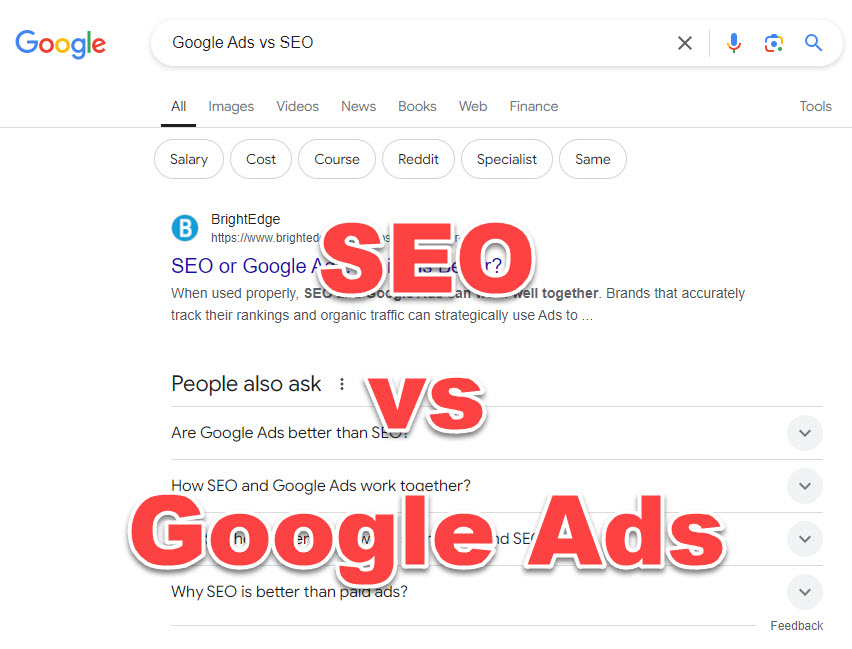
At Little Dragon Media, a lot of clients and prospects often ask us if they should invest in SEO or Google Ads. Now, while our answer is always "If you can afford it, you should do both!" (for several reasons) we understand that some businesses are dealing with a small budget and can only afford one of these marketing channels. If that's your situation, I would respond by saying: "it depends on the KD (Keyword Difficulty) and CPC (Cost-Per-Click) of your main keywords". I'll dive more deeply into that in this article...
Understanding the Pros & Cons
When deciding between SEO (Search Engine Optimization) and Google Ads (formerly known as AdWords), it's crucial to understand the pros and cons of each approach and how factors like Cost Per Click (CPC) and Keyword Difficulty (KD) can influence your decision. Below is a comparison that outlines these aspects, followed by a discussion on the importance of integrating both strategies.
SEO vs. Google Ads: Pros and Cons
| Aspect | SEO (Search Engine Optimization) | Google Ads (Pay-Per-Click Advertising) |
|---|---|---|
| Cost | Generally lower ongoing costs, but requires time and resources for optimization and content creation. | Higher initial costs; you pay for each click, which can add up quickly, especially in competitive markets. |
| Time to Results | SEO typically takes longer to see results, often several months. | Google Ads can deliver immediate results as soon as the campaign is live. |
| Sustainability | Long-term benefits; once rankings are achieved, they can provide consistent traffic with minimal ongoing costs. | Short-term results; traffic stops as soon as the ad budget runs out. |
| Click-Through Rate (CTR) | Organic listings often have higher CTRs compared to ads. | Ads appear at the top of search results, which can drive clicks, but they may be skipped by users who prefer organic results. |
| Keyword Targeting | Requires optimizing for specific keywords, with a focus on relevance and content quality. | Allows precise targeting based on specific keywords, demographics, location, audience segments and more. |
| Scalability | SEO is somewhat scalable but requires more content and backlinks to target additional keywords. | Highly scalable; you can quickly increase budget and target more keywords or audiences. |
| Trust and Credibility | Users tend to trust organic results more, as they perceive them as more credible. | Ads can be effective, but some users may skip them, perceiving them as less trustworthy. |
| Competitiveness | Competition can be high for popular keywords, but lower KD keywords can be easier to rank for. | High competition can lead to high CPCs, making it expensive to compete for top ad positions. |
The Role of CPC and KD in Deciding Between SEO and Google Ads
Now, let's get to the meat of the topic: we at Little Dragon always look at the KD (Keyword Difficulty) and average CPC (Cost-Per-Click) to know whether SEO or Google Ads is more appropriate for our clients' budgets.
For instance, let's take a "Wildlife Removal Company" as an example here. Look at the KD and CPC metrics for the keywords "Raccoon Removal", "Wildlife Removal" and other similar keywords in Canada:
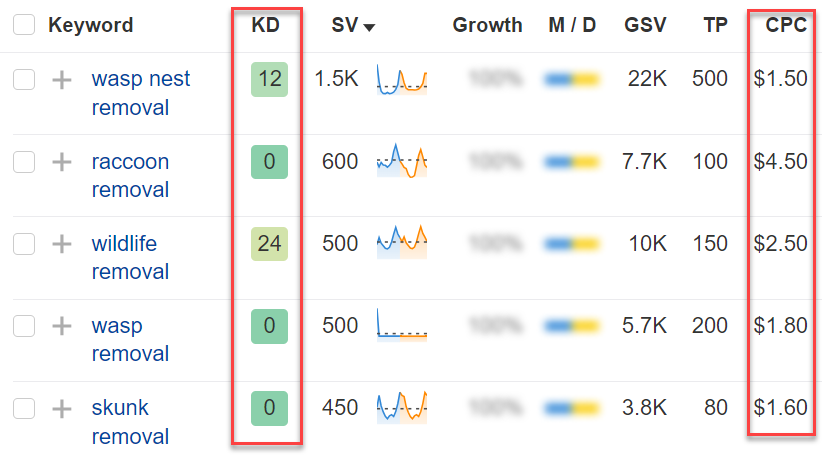
What does this chart tell you?
Well, you can see how the KD is extremely low, meaning it's VERY easy to rank organically for these keywords through SEO, whereas the CPC is quite high, reaching an average of $4.50 per click for "Raccoon Removal" (will probably be even higher in competitive cities like Toronto, Calgary and Vancouver).
This means that if a client in the wildlife removal space reaches out to us, with a limited budget, and asks where they should put their money first, we would definitely recommend SEO! Now, the downside is SEO does take more time, so patience is needed. Google Ads and PPC in general is more immediate. That's why a lot of clients often prefer to go this route.
Summary
- High CPC and Low KD: If a keyword has a high CPC but low Keyword Difficulty (KD), it may be more cost-effective to focus on SEO. Since the keyword is easier to rank for organically, you can potentially save significant money by not paying the high cost per click in a Google Ads campaign.
- Low CPC and High KD: For keywords with low CPC but high KD, Google Ads might be a better choice. The lower CPC makes it affordable to run ads, while the high KD indicates that ranking organically could be challenging and resource-intensive.
- High CPC and High KD: Keywords that are both expensive to bid on and difficult to rank for may require a combination of both strategies or focusing on less competitive keywords.
- Low CPC and Low KD: These keywords present an opportunity to capitalize on both SEO and Google Ads, given their affordability and ease of ranking.
Why You Should Consider Both SEO and Google Ads
As I said before, I always recommend that clients do both SEO and Google Ads, since it gives us the opportunity to own more than one listing on the first page of Google, Bing and other search engines when people search for our target keywords. When doing both, you can benefit from:
A bit of context on why I feel so strongly about this: I've been running Google Ads campaigns since 2009, and I've watched both the platform and SEO evolve side by side for over fifteen years. The lesson that has never changed is that the two channels have opposite personalities. Google Ads is entirely dependent on your budget. The moment you stop spending, your traffic stops with it. SEO is the long-term play: it takes real work up front, but once your website is strong, your content is great and everything is optimized properly, you get organic traffic at zero cost per acquisition for every lead or sale it brings in. We've covered what a realistic Google Ads budget looks like and broken down Google Ads pricing in Canada if you want the numbers side of this.
And there's a bonus most people overlook: running both gives you two listings on page one, one organic and one paid. We've done this for many clients across very different industries, and it consistently improves click-through rate, brand recognition and awareness, because searchers see your name twice before they see a competitor's once.
- Maximized Exposure: Using both strategies allows your brand to dominate the search engine results pages (SERP's) by appearing in both organic listings and paid ads. This can significantly increase your visibility, credibility AND sales.
- Diversified Traffic Sources: Relying solely on one channel can be risky. It's never good to put all your eggs in one basket! By investing in both SEO and Google Ads, you ensure that you have multiple streams of traffic. If one channel underperforms, the other can help maintain overall traffic levels.
- Enhanced Brand Authority: Consistent presence in both organic and paid search results reinforces brand authority. Users are more likely to trust and engage with a brand they see frequently across multiple touchpoints.
- Testing and Optimization: Google Ads allows for quick testing of keyword effectiveness, which can inform your SEO strategy. Conversely, insights from SEO can help refine your Google Ads targeting and messaging. There's huge synergy here.
SEO vs Google Ads: FAQ
Is SEO or Google Ads better for a small business?
If you need leads this month, Google Ads wins because it delivers traffic immediately. If you can invest for the long term, SEO wins because the traffic eventually costs you nothing per click. For most small businesses the honest answer is a mix: ads for immediate flow while your SEO compounds in the background. Our local SEO tips are a good place to start on the organic side.
What happens to my traffic if I stop running Google Ads?
It stops, immediately. Paid traffic is rented, not owned. That's the biggest argument for building SEO alongside your campaigns: organic rankings keep sending visitors whether you spend that month or not, at zero cost per acquisition.
Can running Google Ads improve my SEO?
Not directly, since paid spend is not a ranking factor. Indirectly, yes: ads generate keyword and conversion data you can feed into your content strategy, and having a paid listing next to your organic one increases total clicks and brand searches. That combination is how modern lead generation actually works.
How do I decide my budget split between SEO and Google Ads?
Start with your keywords: high CPC plus low difficulty favours SEO, low CPC plus high difficulty favours ads, and most businesses land somewhere in between. Then look at return rather than spend. Our guide on increasing marketing ROAS without increasing budget covers how to squeeze more from whichever mix you choose. When in doubt, ask a Google Ads specialist to look at your numbers.
Conclusion
Both SEO and Google Ads have unique advantages and can complement each other very well. When deciding where to allocate your marketing dollars in 2026, consider the CPC, KD, and the overall goals of your business. If possible, integrating both strategies will maximize your visibility, drive more traffic, and enhance your brand's online presence.
When in doubt, speak to a search engine marketing company (*ahem* like us *ahem*) and they will analyze your website, industry and keywords to design the best possible digital marketing strategy for your company.

Tech Entrepreneur, Author, and CEO of Little Dragon Media. Passionate about entrepreneurship, philanthropy, digital marketing, blockchain, finance, investing, health fitness & nonprofits.