 647-348-4995


- March 22, 2026
-
 Sarah Bauder
Toronto has the distinction of being the largest and most dynamic metropolis in Canada. With a population of nearly 2.8 million people in the city proper and a downtown core that draws workers, students, tourists, sports fans, and commuters from across the region, suffice it to say that Toronto’s busiest streets are bustling at almost any given moment. That creates major visibility opportunities for brands that want to get in front of large audiences in the real world.
With so many people concentrated in key commercial corridors and intersections, there are numerous locations that can serve as strong environments for a billboard, transit, street-level, or poster campaign. Exceptional advertising poster design is essential if you want to stand out in a city that is constantly fighting for attention. Business owners should also make sure their online presence is ready to convert that attention, which is why strong website design matters just as much as the creative itself.
Here are 5 of the most popular streets and intersections in Toronto to advertise your business, along with why they matter and what kinds of businesses tend to fit them best.
The Intersection at Yonge and Dundas Streets
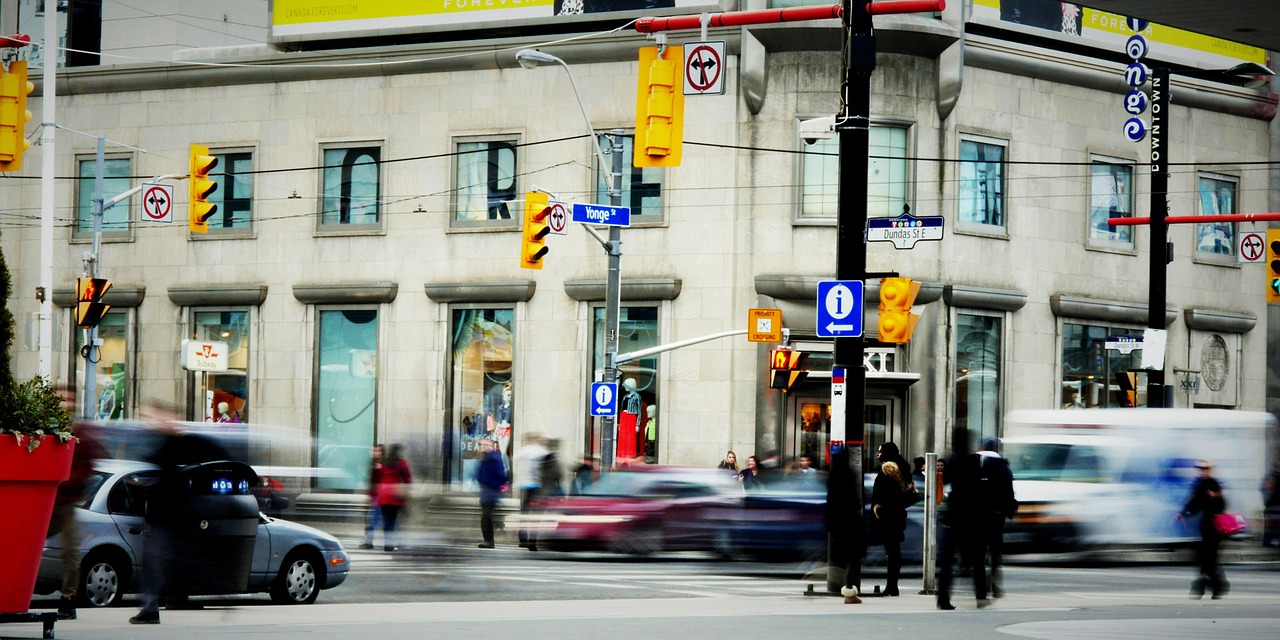
In any conversation about the busiest places in Toronto, Yonge and Dundas is going to be near the top. That has been true for years, and it is still true now. The area remains one of the most intense pedestrian environments in the city, with a constant mix of shoppers, students, tourists, commuters, event-goers, and people simply passing through downtown.
For anyone who lives in Toronto, or at the very least has spent time in the downtown core, it should come as no surprise that this intersection stays active well beyond standard business hours. It is one of the city’s best-known advertising environments because of the sheer amount of foot traffic, visual clutter, and brand competition packed into one place.

Source: TOcore - Phase 1 Taking Stock Transportation Summary Brief
From an advertising standpoint, Yonge and Dundas is best suited for companies that want broad exposure, mass awareness, and a downtown Toronto association. Entertainment brands, retail campaigns, major consumer products, events, restaurants, mobile apps, streaming services, and lifestyle brands can all make sense here. It is not usually the place for a quiet or understated campaign. If you advertise here, your creative needs to be bold, clean, and instantly understandable.
It is also worth remembering that brand visibility alone is not enough. A lot of people may see an ad at Yonge and Dundas, but not every viewer is a qualified buyer. That is why many businesses pair awareness-heavy outdoor campaigns with stronger content marketing, local landing pages, or paid search to capture the interest generated offline.
Dundas Street West and Bay Street
Just west of Yonge and Dundas, the intersection of Dundas Street West and Bay Street is another extremely busy corner in Toronto. It benefits from its proximity to Eaton Centre traffic, office towers, downtown retail, universities, hospitals, and a steady stream of pedestrians moving between transit, shopping, and work.
This corner does not always get talked about as much as Yonge and Dundas, but that is partly what makes it interesting. It still offers strong exposure while feeling slightly more tied to day-to-day downtown movement rather than pure spectacle. In practical terms, it can be a very good fit for brands that want downtown traffic without relying entirely on the most photographed intersection in the city.
Businesses that may fit this area well include financial services, healthcare-related brands, education providers, retail promotions, food and beverage concepts, and companies targeting students or office workers. If your offer is relevant to people on the move, this area can be very compelling.
For businesses looking to advertise around areas like this, message clarity matters even more than design flair. You often have only a second or two to get your point across. That is one reason why well-structured promotional creative tends to outperform busy layouts, whether you are working on print, transit, or digital outdoor placements. The same principle applies to strong brochure and print design in general.
Queen Street West and Bay Street
The intersection of Queen and Bay is another high-traffic area in the downtown core. This corner sits near Toronto City Hall, Old City Hall, Nathan Phillips Square, the Financial District, and a major mix of civic, commercial, and commuter activity. It is one of those places where you get both tourists taking photos and professionals moving fast between meetings.
That mix makes it useful from a branding standpoint. An advertiser here is not just reaching one type of person. They are reaching office workers, visitors, students, legal professionals, local residents, and event attendees. Few intersections in Toronto combine civic symbolism and daily traffic in quite the same way.
If your business wants to feel established, metropolitan, or closely tied to the core of Toronto, Queen and Bay can support that kind of positioning. It can make sense for financial brands, legal and professional services, real estate campaigns, public events, museums, institutions, and brands that want to feel closely connected to the city’s commercial heart.
This area also works well as part of a broader local campaign. A business might use out-of-home advertising here while strengthening its local discoverability through local SEO and branded search coverage. That kind of one-two combination often works better than relying on foot traffic alone.
King Street East and Jarvis Street
Unto itself, King Street is one of the most important east-west corridors in Toronto. It carries major transit movement, connects multiple business and entertainment districts, and has long been associated with commerce, restaurants, hospitality, and downtown life. The King streetcar corridor is one of the best-known transit routes in the city, which adds another layer of visibility and movement for advertisers considering the broader area.
The intersection of King and Jarvis is especially interesting because it sits near St. Lawrence Market, George Brown College, hotels, offices, older heritage buildings, and a growing residential mix. It may not have the sheer spectacle of Yonge and Dundas, but it offers something more targeted: a blend of local, tourist, student, and commuter traffic in an area that still feels very active and urban.
This can be a strong fit for restaurants, hospitality businesses, events, local services, residential developments, fintech brands, food concepts, and businesses that want proximity to both downtown professionals and destination-oriented foot traffic. It is also an area where context matters. An ad that feels too generic may disappear into the background, while an offer that feels local and relevant can stand out nicely.
Yonge Street and Eglinton Avenue
By far, Yonge and Eglinton remains one of the most important advertising nodes in midtown Toronto. It has long been one of the busiest and most commercially significant intersections outside the downtown core, and its role in the city has only grown as the area has densified. The neighbourhood continues to attract major residential growth, office activity, shopping, dining, and transit-oriented movement.
What makes Yonge and Eglinton so attractive is that it offers a different audience mix from the core. Downtown is often about scale, tourism, and business concentration. Yonge and Eglinton offers a strong blend of affluent residents, young professionals, families, commuters, students, and midtown consumers with meaningful spending power. That can make it especially attractive for retail, clinics, education, insurance, professional services, real estate, restaurants, and premium local brands.
The area is also closely tied to some of Toronto’s best-known neighbourhoods and remains an important planning and growth zone within the city. For advertisers, that means it is not just busy now. It is a corridor with long-term commercial relevance.
If your business is more midtown-focused than downtown-focused, this is often one of the smartest places to prioritize. It can be particularly useful for businesses that want reach but still care about neighbourhood quality and household purchasing power, not just raw foot traffic.
What These Streets Are Actually Best For
One thing worth adding to the original article is that the “best” street depends on what kind of advertising you are trying to do. High traffic alone does not automatically make a location ideal.
| Area | Best For | Typical Fit |
|---|---|---|
| Yonge & Dundas | Mass awareness | Retail, entertainment, consumer brands, events |
| Dundas & Bay | Commuter and downtown visibility | Retail, education, healthcare, office-worker offers |
| Queen & Bay | Institutional and business credibility | Finance, legal, public events, real estate, civic campaigns |
| King & Jarvis | Contextual downtown targeting | Hospitality, restaurants, local services, condos, food |
| Yonge & Eglinton | Midtown reach and affluent consumer exposure | Clinics, retail, insurance, family services, real estate |
Downtown vs Midtown: Which Toronto Area Makes More Sense?
If your budget is limited, this is the question you should probably ask first. Downtown Toronto can deliver tremendous visibility, but it can also be broader, more expensive, and less targeted. Midtown locations such as Yonge and Eglinton may offer a more refined local audience depending on what you sell.
As a rule of thumb:
- Choose downtown if you want maximum awareness and citywide visibility.
- Choose midtown if your audience is more residential, professional, family-oriented, or neighbourhood-specific.
- Choose a corridor like King East if your offer benefits from context, hospitality, and mixed downtown traffic.
Many businesses also do best when they support outdoor advertising with digital follow-up. Someone may see your ad on the street, then search your company later. That is why businesses investing in street-level visibility often benefit from stronger Google Business Profile optimization and paid campaigns that help capture branded interest after the initial impression.
Need Help Promoting Your Business in Toronto?
A great location helps, but your creative, targeting, landing page, and follow-up strategy matter just as much. If you want help planning a campaign that ties together design, local SEO, and paid traffic, we’d be happy to take a look.
Final Thoughts
Toronto is a bustling, thriving metropolis. Its streets are not just crucial thoroughfares for moving people. They are also places where people meet, socialize, shop, dine, work, and experience brands in real time. There are several popular streets and intersections in Toronto with both heavy foot traffic and strong commercial relevance, which makes them attractive advertising environments for the right business.
The larger lesson here is that visibility alone is not the whole game. The best advertising locations are the ones that match your audience, your budget, and your offer. Some brands need the spectacle of Yonge and Dundas. Others will get better results from a more context-driven corridor like King East or a more affluent and residential-commercial hub like Yonge and Eglinton.
Because of that, business owners should think beyond just “busy.” They should think about fit, message, and what happens after someone sees the ad. That is where great design, strong positioning, and a well-built digital funnel can really make the difference.
FAQ About the Best Streets in Toronto to Advertise Your Business
What is the best street in Toronto to advertise a business?
Is Yonge and Dundas still one of the busiest places in Toronto?
Is downtown Toronto always better than midtown for advertising?
What kind of businesses benefit most from advertising on busy Toronto streets?
Should I rely only on outdoor advertising in Toronto?

Sarah Bauder is a senior content specialist at Little Dragon Media. Sarah has a degree in journalism and has a decade of experience writing content at numerous renowned publications. She enjoys writing about digital marketing, business, entrepreneurship and more.